Air Conditioning Peptide Screening Laboratories Third-party Peptide Evaluation
Comprehending Peptide Pureness Screening
We use GC-MS, MOTS-c ICP-MS, and various other techniques to spot pollutants, guaranteeing product safety and security and governing compliance. Peptide sequencing is critical for identifying the exact amino acid sequence of peptides, consisting of adjustments like phosphorylation or acetylation. Sequencing enables researchers to understand the biological role of the peptide and its interaction with other particles, assisting in the design of useful peptides for varied applications. The peptide sample is dissolved in a compatible solvent and loaded right into an autosampler.At Maxed Out Compounds, every item we supply comes with a clear testing document and clear documents. Our goal is to support researchers with high-purity, validated compounds that fulfill the needs of modern-day clinical research study-- nothing more, absolutely nothing less. Independent, third-party screening plays a crucial duty in making sure neutrality and precision. By utilizing external Extra resources laboratories for confirmation, vendors eliminate prejudice and promote scientific credibility. It's an extra step that provides researchers self-confidence that each peptide meets regular, proven criteria. This quality suits most of in vitro research study applications-- receptor binding assays, enzyme task studies, and cell culture experiments.
Desalted peptides function well for ELISA covering, some cell-based assays, and applications where modest purity is acceptable. After synthesis and purification, peptides are normally lyophilized (freeze-dried) as salts. One of the most typical counterion is trifluoroacetate (TFA) from the HPLC purification solvents, though some peptides are provided as acetate or hydrochloride salts. These counterions aren't "pollutants" in the HPLC sense-- they don't turn up as separate peaks-- however they do add to the total mass of the powder.- Peptide purity screening information are necessary in preclinical research studies and have to be consisted of in investigational brand-new medication (IND) applications and later brand-new drug applications (NDAs).
- We create logical process around the example kind, series features, adjustment profile, and choice context.
- Recurring natural solvents, steel ions, or by-products from synthesis may create toxic adverse effects.
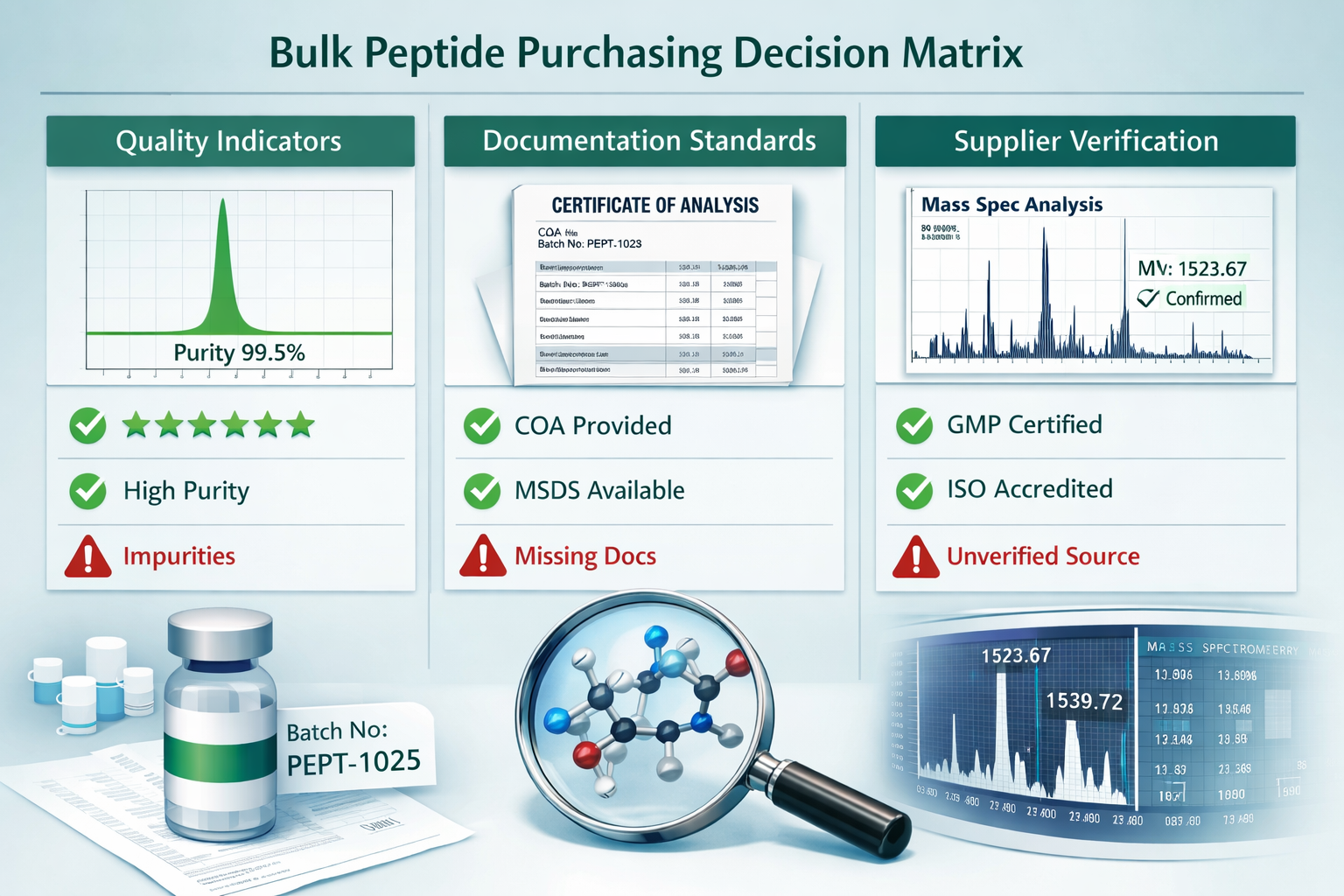
- Beware of COAs that offer a pureness number with no sustaining chromatographic information, record pureness without defining the analytical technique, or checklist a molecular weight without mass spectrometry verification.
Apex Lab Editorial Team
High-performance Liquid Chromatography
If the COA provides "overall contaminations", that enhances the purity number (e.g., 98% pureness indicates 2% total pollutants). Lots of COAs also define well-known or "defined impurities" versus undefined ones, each with their specific percentages if over a specific limit. This level of detail aids researchers recognize if any type of minor peptide byproducts are present. If you see multiple huge heights of comparable height, you're looking at either a low-purity example or a mix. If the primary height has a noticeable "shoulder"-- a bump on one side-- that commonly suggests a carefully associated impurity (like a removal peptide) that the column couldn't fully deal with. The peptide is passed through an easy purification action (frequently gel purification or a fast reversed-phase clean-up) to eliminate salts, small-molecule results, and scavengers from the cleavage action.This degree of extensive evaluation makes sure the peptide's precision-- indicating the sequence and purity are exactly as labeled-- which is vital for experimental reproducibility. By verifying structure with numerous verified methods, laboratory validation guarantees that researchers receive a high-purity peptide that will certainly execute as anticipated in the laboratory. Research laboratory recognition of peptides is not just a clinical ideal practice-- it's frequently a governing requirement when peptides are utilized in restorative advancement or clinical research.In simple terms, a peptide detailed as 95% pure is composed mainly of the target peptide (95%), with the staying ~ 5% comprised of pollutants. These contaminations can include things like reduced or truncated series, removal variations, oxidized residues, or various other minor side-products from the synthesis process. Peptides are widely used in the medical appearances, cosmetics, and biomedical areas as a result of their special organic task and wide application potential. Nevertheless, the high quality of peptide products directly impacts their performance and safety, making accurate quality screening solutions vital.
The gold standard for gauging peptide purity is high-performance fluid chromatography, widely abbreviated as HPLC. If you see a pureness portion on a peptide product, it almost certainly originated from an HPLC analysis. This matters due to the fact that peptides are developed one amino acid each time via solid-phase peptide synthesis (SPPS). At each step, there's a little opportunity that something goes wrong-- an amino acid doesn't attach, the wrong adjustment happens, or a side reaction generates an unplanned result. Over a chain of 10, 20, or 40 amino acids, those little per-step error rates compound. Peptide testing is the collection of analytical checks made use of to review a peptide sample before it is used in a study process. In practical COA evaluation, the term generally refers to pureness testing, identification screening, and documentation evaluation. Pureness screening asks just how much of the detected example is the major peptide versus related contaminations. Identity screening asks whether the determined mass or sequence-related evidence matches the desired peptide. Documentation evaluation asks whether the record is batch-specific, deducible, and described sufficient to be investigated. Peptide testing is the analytical procedure utilized to verify that a research peptide is both pure and appropriately identified.